
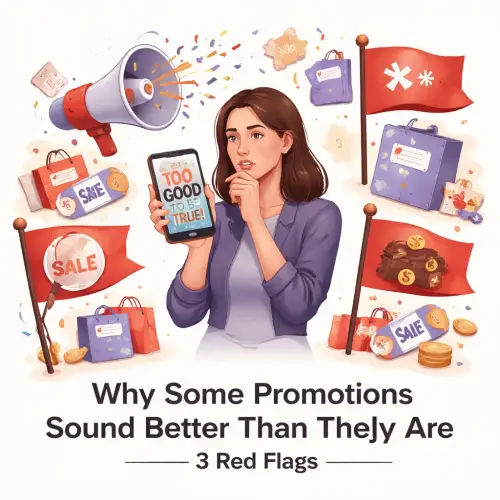
Why Some Promotions Sound Better Than They Really Are Key Takeaways
Why Some Promotions Sound Better Than They Really Are often comes down to a mix of psychological triggers and cleverly hidden fine print.
- Red flag #1: Anchoring with inflated original prices makes discounts look bigger than they are.
- Red flag #2: Scarcity tactics like fake countdowns create false urgency.
- Red flag #3: Hard-to-meet terms and conditions (minimum spends, exclusions) gut the real value.
What Readers Should Know About Why Some Promotions Sound Better Than They Really Are
Have you ever clicked on a promotion and felt let down after reading the fine print? You are not alone. A 2023 study by the Federal Trade Commission found that consumers lose billions annually to deceptive marketing practices. Why Some Promotions Sound Better Than They Really Are is not just a question—it is a warning. This article explains the psychological and economic factors behind misleading promotions, how companies design them, and exactly how you can protect yourself.
The key is understanding that promotions are engineered to trigger emotional responses—excitement, fear of missing out, and the thrill of a deal—rather than rational calculation. Once you see the mechanics, the offers lose their power. For a related guide, see Comparing No Deposit Offers vs Welcome Bonuses: Smart Value Guide.
The Psychology Behind Why Some Promotions Sound Better Than They Really Are
Marketers use known promotion tactics explained by behavioral economists. Daniel Kahneman and Amos Tversky first described anchoring, where a high initial price makes a lower sale price seem like a steal. For example, a mattress originally priced at $3,000 but now $1,400 is presented as a “53% savings.” But if the mattress never actually sold for $3,000, the discount is a fiction.
Scarcity and Urgency: The Panic Button
Another tactic is creating artificial scarcity. You see “Only 3 left in stock” or “Sale ends in 2 hours.” Research from the Journal of Consumer Research shows that scarcity triggers loss aversion—we fear losing an opportunity more than we value the gain. However, many of those countdowns reset when you refresh the page. A 2022 analysis by Consumer Reports found that 40% of online countdown timers in a sample of 200 retailers were fake.
Complex Terms and Fine Print
Some promotions rely on confusion. A “Buy One, Get One Free” offer actually requires you to pay full price for the first item. A “50% off” coupon only applies to select clearance items that you may not want. These are classic examples of why promotions seem better on the surface than they are in practice. For a related guide, see Avoid These Risky Casino Promotions: 5 Expiry Date Traps.
3 Red Flags That Signal a Misleading Promotion
Here are the three most common markers of a promotion that is not what it seems, based on real-world examples and economic principles.
Red Flag #1: Inflated Original Prices (Anchoring)
Anchoring is the most pervasive misleading promotion technique. Retailers list a “Was” price that is artificially high so the “Now” price looks like a huge drop. A famous case involved a furniture chain that listed a sofa at $2,000 for only one week before offering it at “50% off”—$1,000. In reality, comparable sofas from competitors sold for $800. The promotion worked because the inflated original price became the reference point. Always research the market price before being impressed by percentages.
Red Flag #2: Fake Scarcity and Pressure Tactics
Countdown timers, “Limited stock” warnings, and “Exclusive to first 50 customers” are designed to make you act quickly without thinking. In 2021, the FTC charged an online retailer with using false scarcity claims, showing that the items were not actually limited. The psychological effect is real, but the shortage often is not. When you feel rushed, take a step back.
Red Flag #3: Buried Conditions That Slash the Value
Terms like “Minimum purchase of $100 required” or “Not valid on sale items” or “Must be new customer only” can turn a great-sounding offer into a poor one. For instance, a “20% off your entire order” coupon might sound great until you learn it excludes electronics, groceries, and gift cards—covering the very items you intend to buy. A 2023 study by marketing platform Retail Dive found that 65% of coupons had at least one restrictive condition.
Real-World Examples: When Promotions Go Wrong
Let us look at two well-known cases that perfectly illustrate why some promotions sound better than they really are.
Case Study 1: The “Half Off” Furniture Store
A national furniture chain ran a “50% off everything” event. However, the “original” prices were marked up 200% two weeks prior. The National Advertising Division (NAD) investigated and found that only 10% of items had ever sold at the listed original prices. The result: customers paid about the same as they would have at other stores without the promotion. The illusion of savings drove foot traffic.
Case Study 2: The Subscription Trap
An online supplement company advertised “First month for $1!” The fine print—buried in a drop-down box—stated that customers would be automatically charged $89.99 per month thereafter, with auto-renewal enabled by default. A class-action lawsuit later forced the company to refund millions. This is a classic bait-and-switch where the promotional offer is a loss leader to lock you into a costly subscription.
How to Spot Misleading Promotions Before You Buy
Now that you know the red flags, here is a practical checklist you can use every time you consider a promotion.
- Check the original price: Use a price tracker like CamelCamelCamel to see if the “usual” price is real.
- Read the terms: Look for minimum spends, exclusions, expiration dates, and auto-renewal clauses.
- Search for the product elsewhere: Compare across at least three retailers to gauge true market value.
- Wait 24 hours: If the urgency is fake, the offer will still be there tomorrow.
- Use an ad-blocker or incognito mode: Some retailers show different prices based on your browsing history.
Common Mistakes People Make With Promotions
Even savvy shoppers fall for these traps. Here are three mistakes to avoid.
Mistake #1: Focusing Only on the Discount Percentage
A “70% off” sign is visually compelling, but if the product is overpriced to begin with, you save nothing. Always evaluate the final price, not the percentage.
Mistake #2: Ignoring the Fine Print
People skip the fine print because it is small, dense, or hidden behind a link. Yet that is where the real deal-breaker clauses live. Make it a habit to read the terms before adding to cart.
Mistake #3: Falling for Limited-Time Offers Without Verification
Just because the timer says “Last chance” does not mean it is true. Check if the same promotion has been running for weeks. If it is a genuine time-limited sale, it will clearly state the date and time.
Useful Resources
For more on how to protect yourself and understand the psychology behind promotions, check these resources:
- Federal Trade Commission – Consumer Protection: The FTC publishes regular alerts on deceptive pricing and promotion tactics, plus steps to report fraud.
- Consumer Reports – Scams and Frauds: Offers detailed investigations into misleading sales tactics and practical advice for smarter shopping.
Frequently Asked Questions About Why Some Promotions Sound Better Than They Really Are
What does and quot;why some promotions sound better than they really are and quot; mean?
It refers to the gap between how a deal is presented and its actual value, often achieved through psychological tricks, inflated original prices, and hidden terms.
What is a misleading promotion?
A misleading promotion is an offer that uses deceptive claims, fine print, or exaggerated discounts to convince customers that the deal is better than it really is.
What are the most common psychological tricks in promotions?
Anchoring (inflated original price), scarcity (fake limited stock), social proof (false popularity), and loss aversion (urgency to avoid missing out) are the most common.
How can I tell if a sale price is real?
Use price history tools like CamelCamelCamel, compare across multiple retailers, and check whether the “original” price was ever the actual selling price.
Are countdown timers always fake?
Not always, but a study by Consumer Reports found that about 40% of online countdown timers in a sample were not tied to genuine deadlines and would reset after expiring.
What is anchoring in marketing?
Anchoring is a cognitive bias where people rely heavily on the first piece of information (the anchor) presented, like a high original price, to make subsequent judgments about value.
Is and quot;Buy One, Get One Free and quot; always a good deal?
Not necessarily—sometimes the price of the single item is inflated, meaning you pay the same or more than you would for two items elsewhere.
What should I look for in the fine print?
Look for minimum purchase requirements, exclusions (category, brand, or item), expiration dates, auto-renewal terms, and whether the discount is off the original or sale price.
Why do stores use fake original prices?
Fake original prices create a strong anchor that makes the discounted price appear much more valuable, even if the discount % is not as high as it seems.
Can I trust customer reviews under a promotion?
Be cautious—some stores publish reviews only from users who got the promotional price, which can bias the feedback positively. Look for reviews from verified purchasers.
What is the biggest financial risk with misleading promotions ?
The biggest risk is committing to a subscription or purchase you do not need because the promotion makes it seem too good to pass up, leading to buyer’s remorse or recurring charges.
Are and quot;limited time only and quot; offers always false?
Not always, but many are. Check if the same offer reappears after the timer ends. Genuine limited-time offers usually specify a clear end date and time visible in the terms.
What is the and quot;decoy effect and quot; in promotions?
The decoy effect happens when an option is added to make another option look better. For example, a small popcorn at $5, medium at $7, and large at $7.50 makes the large seem like a great deal.
How do subscription traps work?
A trap offers an extremely low introductory price but enrolls you in a high-cost recurring subscription with auto-renewal. The terms are usually hidden in small print or a collapsible box.
Can I report a misleading promotion?
Yes, you can file a complaint with the Federal Trade Commission (FTC), the Better Business Bureau (BBB), or your state’s attorney general office.
What is price anchoring vs price framing?
Anchoring uses a single high reference point to make a price seem low, while framing presents the same price in a positive light (e.g., “only $1.50 per day” instead of $550 per year).
Are all and quot;50% off and quot; promotions dishonest?
No, but you should verify that the original price reflects the typical market price, not an inflated MSRP that rarely sells at that level.
Why do I feel pressure to buy during a promotion?
Marketers engineer urgency through artificial scarcity and time limits, which taps into loss aversion—the fear of missing out overrides rational decision-making.
What is the best way to compare promotional offers?
Always calculate the final price after all discounts and fees, then compare that against the average market price for a similar product from at least three different retailers.
How can businesses offer genuine promotions without being misleading?
By being transparent—clearly showing the basis for original prices, making terms easy to find and read, and avoiding false scarcity claims. Honesty builds long-term trust.