

transparency helps beginners feel more comfortable Key Takeaways
Transparency helps beginners feel more comfortable by removing guesswork, setting clear expectations, and creating a safe space for questions.
- Transparency helps beginners feel more comfortable because it replaces uncertainty with predictable structure.
- Clear rules and honest examples give beginners a mental map, reducing the fear of making mistakes.
- Open feedback loops show beginners that questions are welcome and growth is the goal, not perfection.
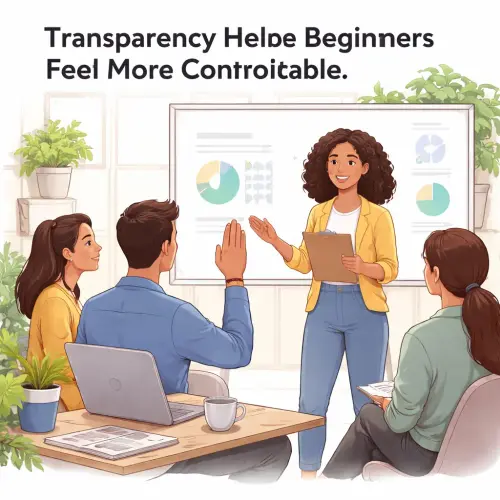
Why Beginners Feel Uneasy (and How Transparency Helps Beginners Feel More Comfortable)
Starting something new is vulnerable. Whether it’s learning a software tool, joining a community, or beginning a fitness routine, beginners face a storm of unknowns: “What if I do it wrong?” “What if everyone judges me?” “What if I miss a hidden rule?” This anxiety is normal, but it doesn’t have to be permanent.
The root cause is ambiguity. When expectations, processes, and consequences are hidden, beginners feel like they’re walking in the dark. That’s exactly where transparency helps beginners feel more comfortable. By bringing what’s hidden into the open, you replace fear with curiosity and hesitation with action. For a related guide, see Gambling Terminology: 7 Simple Ways to Decode Confusing Terms.
The Trust Gap in New Experiences
Research shows that trust is built on predictability (check out this Harvard Business Review piece on the elements of trust). When a beginner can predict how a system will respond, they relax. Transparency delivers that predictability. It says, “Here are the rules. Here’s what success looks like. Here’s how you’ll be evaluated.”
7 Proven Ways Transparency Helps Beginners Feel More Comfortable
These seven strategies move from theory to practice. Each one directly reduces the anxiety beginners feel and builds lasting trust.
1. Publish Clear Rules and Expectations Upfront
Before a beginner takes their first step, they need a map. Write down every rule, deadline, format requirement, and behavioral expectation. Put it in a single, easy-to-find document. When transparency helps beginners feel more comfortable starts with “here’s exactly what to expect,” they can focus on learning instead of guessing. For a related guide, see Why RTP Discussions Matter: 5 Smart Reasons for Slot Players.
Example in Practice
A coding bootcamp that publishes its syllabus, grading rubric, and instructor bios before enrollment reduces dropout rates because students know what they’re signing up for.
2. Share Honest Examples of Work (Including Mistakes)
Beginners often compare themselves to polished final products. When you show real examples—including early drafts, failed attempts, or “before” versions—you normalize the learning curve. Transparency helps beginners feel more comfortable by letting them see that everyone starts somewhere messy.
Pro Tip
Include a “what went wrong” section in your case studies. A design agency that shows three rounds of wireframes (including the client’s rejection) teaches more than a perfect final mockup ever could.
3. Create Open Feedback Channels
Beginners need a safe way to ask questions and receive feedback. This could be a dedicated forum, anonymous Q and A, or regular office hours. When feedback is transparent—meaning everyone can see common questions and answers—the whole group learns faster.
Why It Works
If one beginner asks, “How do I format this report?” and the answer is public, ten other beginners see the answer without having to ask. This builds a culture where transparency helps beginners feel more comfortable because no one feels silly for not knowing.
4. Explain the “Why” Behind Decisions
When beginners understand the reasoning behind a rule or process, they are far more likely to follow it willingly. Explain not just what to do, but why it matters. This turns compliance into comprehension.
Real-World Shift
A company onboarding manual that says “Submit timesheets by 5 PM Friday” feels arbitrary. Adding “so payroll can process on time and you get paid Monday” turns a rule into a shared goal.
5. Use Transparent Progress Tracking
Show beginners where they are relative to the finish line. A clear progress bar, checklist, or milestone map removes the anxiety of “am I falling behind?” When learners can see their own progress, they feel a sense of control.
Tool Suggestion
Learning platforms like Duolingo or Khan Academy use visible progress markers. You can do the same with a simple shared spreadsheet or checklist.
6. Model Vulnerability from Leaders
When instructors, managers, or community leaders admit their own mistakes or uncertainties, it signals that it’s safe to be imperfect. This kind of social transparency helps beginners feel more comfortable by lowering the “performance pressure” that often paralyzes new learners.
Leadership Habit
Start a meeting or lesson with “Here’s something I tried that didn’t work, and here’s what I learned.” It sets a tone of honest exploration.
7. Provide a Transparent Grievance or Escalation Process
Beginners worry about what happens if they have a problem. A clear, written process for raising concerns or appealing decisions builds deep trust. It tells beginners, “You have a voice, and we will listen.”
How to Implement
Publish a one-page “What to do if you have an issue” guide. Include contact names, expected response times, and a sample step-by-step flow. This final layer of transparency helps beginners feel more comfortable because it covers the worst-case scenario.
Common Mistakes That Undermine Transparency for Beginners
Even good intentions can backfire. Here are three traps to avoid.
Over-Sharing Without Context
Dumping raw data or long documents on beginners can overwhelm them. Transparency isn’t about volume; it’s about relevance. Share what they need, when they need it, in digestible chunks.
Forcing Transparency Too Fast
Some beginners need privacy while they learn. Don’t require public posting of all work right away. Offer optional sharing first, then gradually encourage openness as trust builds.
Ignoring Feedback Once It’s Shared
If you ask for feedback and then never act on it, you break trust. Transparency requires a loop: invite input, acknowledge it, and show what changed as a result.
Practical Tips for Implementing Transparency Helps Beginners Feel More Comfortable
Ready to apply these ideas? Start small and build momentum.
- Audit your onboarding. Review every step a beginner takes. Where is the ambiguity? Add a clear rule or example at that exact point.
- Create a “Beginner FAQ” document. Collect the top 20 questions newbies ask and answer them publicly. Update it monthly based on real questions.
- Record a “Day in the Life” video. Show what a typical first week looks like, including mistakes and small wins.
- Use a shared kanban board. Let beginners see the full process from idea to completion. It demystifies the workflow.
- Set up a weekly “Ask Me Anything” thread. Make it a regular, low-pressure space for questions.
Useful Resources
For a deeper dive into the psychology of trust and transparency in learning environments, check out these external resources:
- The Psychology of Trust: How It Forms and Why It Matters — A comprehensive guide from PositivePsychology.com on the mechanisms of trust.
- Creating a Culture of Transparency in the Classroom — Practical strategies for educators and team leaders from Edutopia.
Frequently Asked Questions About transparency helps beginners feel more comfortable
How does transparency help beginners feel more comfortable ?
Transparency removes the unknown. When beginners know exactly what to expect, what is expected of them, and how they will be evaluated, their anxiety decreases and they feel safer to explore and learn.
What is the first step to adding transparency for beginners ?
Start by writing down all rules and expectations in one clear document. Make it easy to find and update it regularly based on beginner questions.
Can too much transparency overwhelm beginners?
Yes. Share information in layers. Give beginners the essential rules first, then offer deeper resources as they progress. Relevance matters more than volume.
Why do beginners feel anxious in new environments?
Anxiety comes from uncertainty about expectations, fear of judgment, and lack of control. Transparency directly addresses all three by providing structure and predictability.
How does sharing mistakes help beginners?
Seeing that experts also make mistakes normalizes imperfection. It lowers the performance pressure and encourages beginners to try without fear of failure.
What is an example of transparency in a classroom?
A transparent classroom posts the syllabus, grading rubric, and sample student work. The teacher also explains why assignments matter and offers open office hours.
How does transparency build trust?
Trust grows when actions match promises. Transparency shows consistency and honesty, which are the foundation of trust according to psychology research.
What is a feedback loop in transparency?
A feedback loop means you invite input from beginners, acknowledge it, and then show how you used it. This proves you value their voice and builds deeper trust.
Can transparency work for remote teams?
Absolutely. Remote teams benefit even more from clear documentation, visible progress tracking, and open communication channels since face-to-face cues are missing.
How often should I update transparency materials?
Review your rules, FAQs, and examples every quarter. Update them immediately whenever a process changes or you notice a pattern of similar beginner questions.
What if a beginner breaks a rule that was transparent?
Treat it as a learning opportunity. Refer back to the published rule, explain the reasoning again, and offer support. Consistency in enforcement is key to maintaining trust.
How do I encourage beginners to ask questions?
Normalize questions by celebrating them. Create a dedicated space for Q and A, answer promptly, and publicly thank people for asking good questions.
Does transparency work in competitive environments?
Yes, but it must be balanced. You can transparently share process and criteria without revealing every individual’s performance. Focus on systems, not comparisons.
What is the biggest mistake when trying to be transparent?
The biggest mistake is sharing information without context. Transparency without explanation can confuse or overwhelm. Always pair data with a clear “why.”
How do I handle sensitive information transparently?
Be transparent about your boundaries. Say, “I can share X, but Y is confidential for these reasons.” Honesty about limits still builds trust.
Can transparency help with imposter syndrome?
Yes. When beginners see honest examples of others’ struggles and progress, they realize feeling like an impostor is normal and part of the learning process.
What tools support transparency for beginners ?
Simple tools work best: shared Google Docs for rules, Trello or Notion for progress tracking, Slack or Discord for open Q and A, and Loom for video walkthroughs.
How do I measure if transparency is working?
Track beginner engagement, question volume, completion rates, and satisfaction surveys. A drop in repeated questions often signals that transparency is effective.
Is transparency the same as oversharing?
No. Transparency is purposeful and relevant. Oversharing is unfiltered and often counterproductive. Aim to share what beginners need, not everything you know.
Where can I learn more about transparency for beginners ?
Start with the resources linked above, then explore books like “The Trusted Advisor” by David Maister and “Dare to Lead” by Brené Brown for deeper insights.