
gambling terminology Key Takeaways
We’ve all been there—staring at a screen full of terms like “parlay,” “juice,” and “over/under” that feel like another language.
- Gambling terminology can be grouped into simple categories like betting types, odds, and actions, making it easier to learn.
- Understanding odds formats (American, Decimal, Fractional) is the foundation for knowing your potential payout.
- Everyday terms like “vig,” “action,” and “futures” are easier to remember with real-life examples.
Why gambling terminology Feels Like a Foreign Language
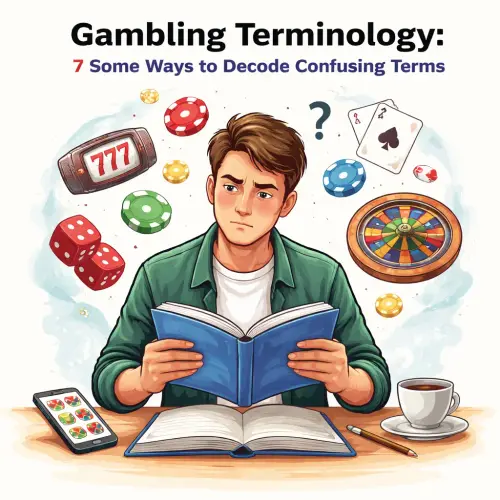
If you’ve ever placed a bet or just watched a game with friends who gamble, you’ve probably heard a string of confusing words. Gambling terminology is often borrowed from sports, poker, and casino games, but the same word can mean different things in different contexts. The key is to learn the core categories—once you do, the jargon becomes a tool, not a barrier. For a related guide, see 7 Essential Digital Slot Game Mechanics Every Beginner Must Know.
In this guide, we’ll decode the most widely used simple gambling terms by grouping them into four buckets: Betting Types, Odds and Payouts, Actions and Rules, and Slang. We’ll wrap up with a glossary and an FAQ to cement your knowledge.
Betting Types: The Building Blocks of Gambling Definitions
Before you place a wager, you need to know what kind of bet you’re making. Here are the most common types you’ll encounter.
Straight Bet
The simplest form of betting. You pick one team or outcome to win. If it wins, you get paid. Example: “I’ll bet $10 on the Patriots to beat the Bills.” If the Patriots win, you win.
Parlay
A parlay combines two or more bets into one wager. All selections must win for you to get paid. The payout is higher because the risk is greater. Example: A $5 parlay on three teams that all win pays a lot more than three separate $5 bets.
Over/Under (Totals)
You bet on whether the total combined score of both teams will be over or under a number set by the sportsbook. Example: A football game has an over/under of 45.5. If the final score is 27–20 (47 total), “over” wins. If the score is 21–17 (38 total), “under” wins.
Futures
Bets placed on an event that will happen in the future, like who will win the Super Bowl next year. Example: Betting on the Chiefs to win the Super Bowl before the season starts. Odds change throughout the season.
Proposition Bet (Prop Bet)
A bet on a specific occurrence within a game, not the final outcome. Example: “Will Player X score the first goal?” or “How many strikeouts will Pitcher Y have?”
Odds and Payouts: The Math Behind Simple Gambling Terms
Odds tell you how much you can win and how likely an outcome is. Three main formats exist, but we’ll focus on American odds, which are most common in the U.S.
American Odds (Moneyline)
Expressed as a positive or negative number. A negative number (e.g., -150) means you need to bet $150 to win $100. A positive number (e.g., +200) means a $100 bet wins $200.
Example: If the Lakers are -200 to win, you’d bet $200 to profit $100. If the underdog Knicks are +180, a $100 bet wins $180.
Decimal Odds
Popular in Europe and Canada. Multiply your stake by the decimal to find total return. Example: Odds of 2.50 mean a $10 bet returns $25 ($15 profit).
Fractional Odds
Used in the UK. Written as 5/1 (read “five to one”). For every $1 you bet, you win $5. Example: Bet $20 at 5/1 → win $100.
Actions and Rules: How to Use Gambling Terminology in Real Life
These terms describe the mechanics of placing bets and the rules that govern them.
The Vig (or Juice)
The commission the sportsbook charges for taking your bet. Usually built into odds. Example: In a standard point spread bet, you risk $110 to win $100—the extra $10 is the vig.
Action
A bet is considered “action” when it’s placed and active. “No action” means the bet is void (often due to a canceled game or a player not playing).
Handle
The total amount of money wagered on a game or event. Example: “The handle for the Super Bowl this year was $300 million.”
Chalk
The favorite team or outcome. “Chalk” refers to the higher odds that come with betting on a favorite. Example: “The Chiefs are heavy chalk against the Raiders.”
Push
When the final result matches the line exactly, and everyone gets their money back. Example: If a spread is -3.5 and the favorite wins by 3, the bet is a push (but with half-point spreads, pushes are rare).
Slang and Everyday Gambling Definitions
Casual gamblers use a lot of shorthand. Here’s what they mean.
Bankroll
The total amount of money you’ve set aside for gambling. Smart bettors never gamble with rent money—bankroll management is key. For a related guide, see Why Crypto Transactions Appeal to Casino Players: 5 Smart Benefits.
Tilt
Playing emotionally after a loss. Example: “He lost two hands in a row and went on tilt, chasing his losses.”
Square
A casual or inexperienced bettor. Example: “Squares take the favorite, while sharps look for value.”
Sharp
An experienced, professional bettor who wins consistently.
Middle
Betting on both sides of a line change to guarantee profit. Example: If the line moves from -3 to -2.5, you bet both sides to “middle” the game.
| Term | Category | Simple Example |
|---|---|---|
| Parlay | Bet Type | Bet on 3 teams, all must win |
| Vig | Action/Rule | The $10 fee on a $110 bet |
| Sharp | Slang | A pro who beats the books |
| Totals | Bet Type | Will total points be over or under 45.5? |
| Push | Action/Rule | Tie result, money refunded |
How to Master Gambling Terminology Fast
Here’s a quick three-step system to lock in these simple gambling terms for good.
Step 1: Learn by Category
Don’t try to memorize 50 words at once. Focus on one category—say, “betting types”—until you can explain each term to a friend.
Step 2: Use Real Examples
Don’t memorize definitions in isolation. Attach each term to a specific scenario. For instance, gambling terminology like “futures” sticks better when you think about betting on next year’s Super Bowl.
Step 3: Practice with Small Stakes
Open a sportsbook account with a small deposit or use a free betting app. Place a few small bets while writing down the terms you encounter. Experience is the best teacher.
Common Mistakes Beginners Make with Gambling Definitions
Even after learning the words, new bettors slip up. Here’s what to watch out for.
Mistake 1: Confusing “Odds” with “Probability”
Odds reflect payout, not true probability. A team can have high odds but an even higher chance of winning. Understand the difference before you bet.
Mistake 2: Ignoring the Vig
Beginners often focus only on the betting line and forget about the juice. Always check the implied probability of your bet, including the vig.
Mistake 3: Chasing Losses
When you lose, the temptation is to bet bigger to win it back. That’s “tilt” behavior. Stick to your bankroll plan.
Useful Resources
For a deeper dive into gambling terminology and responsible gambling practices, check out these vetted sources:
- American Gaming Association – Glossary of Sports Betting Terms – A comprehensive list of terms used in legal sports betting.
- Responsible Gambling Council – Glossary – Clear gambling definitions with a focus on player safety and responsible gaming.
Frequently Asked Questions About gambling terminology
What is the difference between a straight bet and a parlay?
A straight bet is a single wager on one outcome. A parlay combines multiple bets into one, requiring all selections to win, with a higher payout potential.
What does “vig” mean in betting?
Vig, short for vigorish, is the fee the sportsbook charges for taking your bet. It’s built into the odds, typically making you risk $110 to win $100.
How do American odds work?
American odds show how much you need to bet to win $100 (negative numbers) or how much you win on a $100 bet (positive numbers). Example: -150 means bet $150 to win $100.
What is a push in gambling?
A push occurs when the final result exactly matches the betting line, resulting in a tie. The bettor gets their stake refunded.
What is a futures bet?
A futures bet is a wager placed on an event that will happen in the future, such as the winner of a championship, often placed weeks or months in advance.
What does “action” mean in sports betting?
“Action” refers to a bet that is active and can win or lose. If a bet is “no action,” it is void and the stake is returned.
What is a proposition bet (prop bet)?
A prop bet is a wager on a specific occurrence within a game, not the final outcome. Example: Will a certain player score a touchdown?
What are decimal odds?
Decimal odds show total return per unit staked. For odds of 2.50, a $10 bet returns $25 (including stake). They’re common in Europe and Canada.
What are fractional odds?
Fractional odds, popular in the UK, show profit relative to stake. Odds of 5/1 mean you win $5 for every $1 bet, plus your stake back.
What is a “middle” in betting?
A middle involves betting both sides of a line change to guarantee profit if the final score lands between the two lines.
What is the difference between a square and a sharp?
A square is a casual bettor, often betting on favorites with no strategy. A sharp is an experienced professional who analyzes value and moves lines.
What is bankroll management?
Bankroll management is the practice of setting aside a specific amount of money for gambling and betting only a percentage of it per wager to avoid going broke.
What does “chalk” mean?
“Chalk” refers to the favorite team in a matchup. A “heavy chalk” is a strong favorite, often with low payout odds.
What is a half-point in betting?
A half-point (e.g., -3.5) eliminates the possibility of a push. Games finish with whole numbers, so a half-point spread guarantees a win or loss for the bettor.
What does “handle” mean?
Handle is the total amount of money wagered on a game, event, or over a period. It’s not profit—it’s the gross amount bet.
What is a “hook” in gambling?
“Hook” is slang for a half-point in the spread. Bettors say “the hook caught them” when a half-point causes a loss instead of a push.
What does “tilt” mean?
Tilt refers to playing emotionally after a loss, often leading to poor decisions and chasing losses. It’s a term borrowed from poker.
What is a moneyline bet?
A moneyline bet is a straight wager on which team or player will win an event, with odds expressed as positive or negative numbers.
What is the “over/under” bet?
The over/under is a bet on whether the total combined score of both teams will be above or below a number set by the sportsbook.
How can I learn gambling terminology fast?
Focus on one category at a time, attach each term to a real example, and practice with small bets. Use glossaries from trusted sites like the American Gaming Association.