

simplicity beats flashy promotions Key Takeaways
In a world overflowing with loud banners, pop-ups, and exaggerated claims, simplicity beats flashy promotions every time.
- simplicity beats flashy promotions because it respects the customer’s time and intelligence.
- Simple campaigns are easier to remember, share, and act on—leading to better long-term roi.
- Real-world examples from brands like basecamp and mailchimp show that clear, direct marketing outperforms complicated stunts.
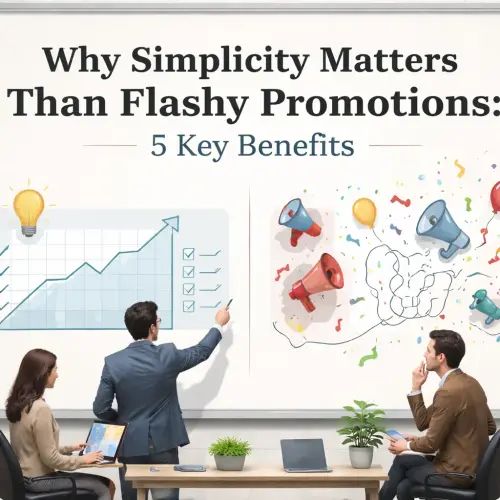
Why simplicity beats flashy promotions in 2025
You open your inbox, and it is a battlefield of blinking gifs, countdown timers, and “limited-time-only” screaming. Yet most of these flashy promotions are ineffective—they get a glance and a click to spam. Consumers are exhausted. They have learned to tune out the noise. That is where the quiet power of simplicity marketing wins. When you strip away the clutter, you leave only value.
Think about the best marketing you have seen lately—a single line of copy on a billboard, a plain product page with one clear button, an email that says exactly one thing. These seem effortless, but they are deliberate. Less is more in marketing is not a cliché; it is a strategy that respects the audience.
Problem: Flashy Promotions Are Falling Flat
Every brand wants to be heard, so many pile on more: more color, more animation, more urgency. Yet the data tells a different story. A study by Nielsen Norman Group found that users ignore cluttered layouts and focus on simple, text-heavy pages that answer their question fast. Flashy promotions are ineffective because they trigger cognitive overload. When a person sees a complex ad, their brain shuts down, not because it is stupid, but because it is protective.
Real anecdote: A local coffee shop spent 2,000 on a flashy social media campaign with filters, giveaways, and daily puzzles. Engagement was low. A month later, they posted one clear photo of their new latte with the caption “Tastes like Saturday.” That post sold more coffee. Why? It was simple, human, and direct. For a related guide, see How Trust Affects Online Casino Choices: 5 Key Factors.
Benefit 1: Simplicity Builds Trust Quickly
Trust is the most valuable currency in marketing, and it is built on clarity. When you make a promise in plain language, customers believe you because you are not hiding behind smoke. Simplicity marketing means being transparent: your price is clear, your offer is obvious, your call to action is one step.
Example: Mailchimp
Mailchimp has long used a clean, almost playful interface. Their landing pages do not scream at you. They ask: “Send better emails.” That is simple. Their revenue? Over $800 million annually because businesses trust a tool that does not complicate what should be straightforward. For a related guide, see How Trust Affects Online Casino Choices Today: 5 Key Factors.
Benefit 2: Simple Messages Are Remembered Longer
Memory works best with patterns, not chaos. Less is more in marketing because a single strong idea sticks more than a list of twenty features. Think of Apple’s “1,000 songs in your pocket.” That is not a technical spec; it is a easy-to-remember message that sold millions of iPods.
Example: Dollar Shave Club
Their launch video was low budget—just a founder talking to the camera in a warehouse. It was not flashy, but it was clear: high-quality razors for a dollar. The message was simple. The company was bought for $1 billion.
Benefit 3: Simplicity Drives Faster Action
Every extra click, every extra sentence, every extra image reduces conversion rates. A study from HubSpot showed that reducing landing page form fields from 11 to 4 increased conversion by 120%. That is the power of simplicity. simplicity beats flashy promotions because it removes friction.
Checklist: How to Simplify Your Next Campaign
- Limit your headline to 8 words.
- Remove one section from your landing page (less is more).
- Use one call-to-action per page.
- Test your email without any images—is the text enough?
Benefit 4: Simplicity Works Across Every Channel
A flashy promotion might look great on Instagram but fail in an email. Simple strategies work everywhere: in print, on social, in store, and in direct mail. Less is more in marketing ensures consistency. When you overcomplicate, each channel requires a different execution. Simple concepts are portable.
Example: Basecamp
Basecamp markets itself with honest simplicity. Their homepage says: “Basecamp is all you need.” No feature lists, no comparisons. They use the same approach in emails, ads, and blog posts. It works because it is true and consistent. They generate over $50 million in annual revenue.
Benefit 5: Simplicity Attracts the Right Customers
When you use flashy promotions are ineffective tactics, you attract people who chase offers—not people who value your product. Simple marketing attracts customers who actually need what you offer. You spend less time dealing with returns, complaints, and refunds because expectations are set clearly from the start.
How to Audit Your Marketing for Simplicity
- Read your homepage aloud. Does it make sense to a 12-year-old?
- Remove half of the text on your product page. Is the message still there?
- Ask someone outside your industry what they think your offer is. If they hesitate, simplify.
Call to Action: Audit Your Own Marketing This Week
The most successful marketers do not scream the loudest. They speak the clearest. This week, pick one campaign—an email, a landing page, a social post—and simplify it. Reduce the offer to one sentence. Remove the decoration. Test it. See if simplicity beats flashy promotions in your own numbers. You might be surprised at how much you win by cutting away.
Useful Resources
Nielsen Norman Group offers research on how users interact with simple versus cluttered designs—essential reading for any marketer.
HubSpot’s marketing statistics include concrete data on how simplicity improves conversion rates across industries.
Frequently Asked Questions About simplicity beats flashy promotions
What does simplicity beats flashy promotions mean?
It means that clear, direct marketing messages perform better than complicated, attention-grabbing tactics because they build trust and reduce confusion.
Are flashy promotions are ineffective in all industries?
Not always, but they tend to be less effective for selling complex, high-value services or products where trust is critical. In entertainment or impulse purchases, flash can still work, but simplicity usually yields higher long-term loyalty.
How do I start using less is more in marketing ?
Begin by cutting one element from your current campaign—an image, a paragraph, a button. Test the results. Repeat. There is no faster way to see the benefit.
Does simplicity mean boring design?
Not at all. Simplicity is about clarity, not lack of creativity. You can still use color and well-placed design, but every element should have a clear purpose that serves the message.
Can simplicity work for small businesses?
Especially well. Small businesses have smaller budgets, so every dollar must earn its place. Simplicity avoids wasted spend on complex campaigns that may not convert.
What is the biggest mistake in simplicity marketing ?
Trying to simplify everything at once. Choose one small piece first—one email, one landing page—and test it before overhauling your whole strategy.
How do I measure if simplicity is working?
Track conversion rates, time on page, and click-through rates. A simple message often reduces bounce rates and boosts conversions within weeks.
Why do companies still use flashy promotions are ineffective tactics?
Many companies chase short-term novelty or follow trends without testing. Plus, flashy campaigns look exciting to internal teams, even if they underperform with customers.
Does simplicity apply to B2B marketing?
Absolutely. B2B buyers are even more overloaded with information. A clear message about saving time or money resonates far better than a complex feature comparison.
What is an example of a brand that uses less is more in marketing well?
Apple. Their product launches focus on one product at a time with a clear benefit. Their ads are minimalist, with white space and a single focal point.
Can I combine simplicity marketing with social media?
Yes. Post one clear idea per post. Use plain text or a single image. Do not clutter with links and multiple calls-to-action.
How do I simplify my email marketing?
Set one goal per email. Remove the sidebar. Use a single headline. Write short paragraphs. Use one button. Test it.
Is there a case where flashy promotions are ineffective claim false?
For one-time event-driven marketing like a flash sale for a nightclub, flash can work. But for sustainable brand growth, simplicity wins.
How do I get stakeholders to approve a simple campaign?
Show them the data—case studies, A/B test results, and examples from big brands. Often a simple landing page outperforms a complex one by 50% or more.
What are the key elements of a simple marketing message?
A clear audience, one problem, one solution, and one call to action. Everything else is optional.
Does simplicity reduce creativity?
No. It forces creativity within constraints, which often produces more innovative ideas than unlimited options.
Can I use humor with simplicity?
Yes. Humor can be simple. A single funny sentence works better than a complex joke with layers of context.
How long before I see results from simplifying?
Often immediately in terms of clarity. Conversion tests can show improvement within days or weeks depending on traffic.
What tools help with simplicity marketing ?
Tools like Hemingway Editor for writing, Unbounce for landing page testing, and hotjar for user recordings help you spot where complexity is hurting conversion.
Where can I learn more about less is more in marketing ?
Read books like “Made to Stick” by Chip Heath and Dan Heath, or follow blogs like Copyhackers and Marketing Examples for practical simple campaigns.